Establish a Subsidiary in Italy
The article presents relevant information about establishing a subsidiary in Italy and the main advantages of running this type of company.

Ready to open a subsidiary in Italy in 2026 and need guidance? You may explore the following article and then access our online services for personalized support from our Italian agents.
| Quick Facts | |
|---|---|
| Applicable legislation (home country/foreign country) | Italian Company Law |
Best used for | – banking, – insurance, – trading, – manufacturing |
Minimum share capital | Yes |
| Time frame for the incorporation (approx.) | Around 1 week |
| Management (local/foreign) | Local |
| Legal representative required | No |
| Local bank account | Yes |
| Independence from the parent company | Yes |
| Liability of the parent company | No, the subsidiary is fully liable |
| Corporate tax rate | 24% |
| Possibility of hiring local staff | Yes |
Is a subsidiary 100% foreign owned? Is a local business partner needed for this type of entity?
A subsidiary in Italy can be 100% foreign owned. There is no need for a local Italian partner to set up such a business structure.
What are key characteristics of subsidiaries in Italy?
- it is a separate legal entity; therefore, it has its own legal entity & management structure,
- can carry out the activities under a different name than the parent company,
- can develop other operations too,
- the subsidiary’s assets are protected against losses, creditors, etc.
What is the proper business structure for a subsidiary in Italy?
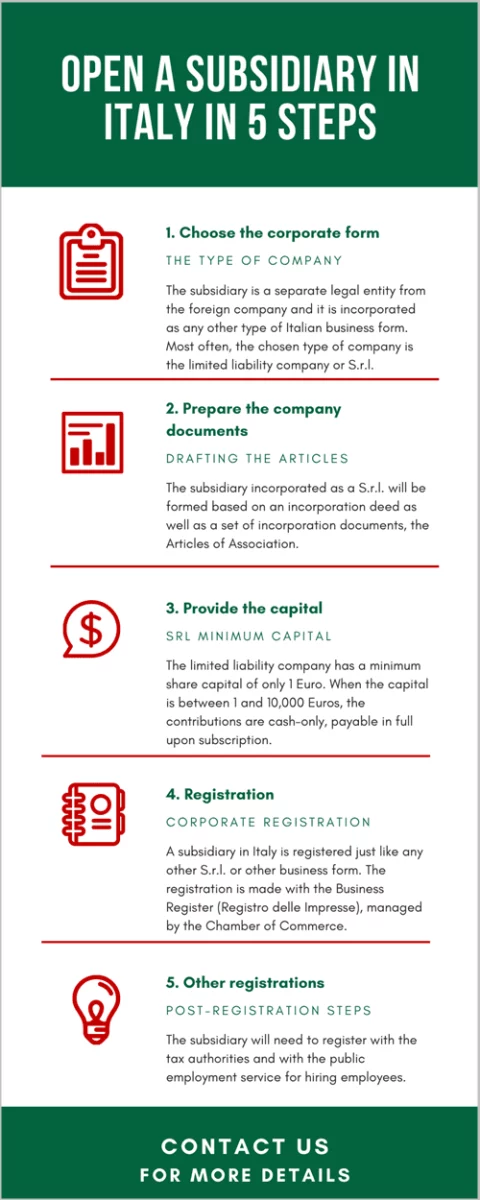
The limited liability company – SRL in Italy.
Below is an infographic with details about subsidiaries in Italy:
What is the minimum share capital to set up a subsidiary in Italy?
EUR 1 (EUR 10,000 is the standard SRL capital; EUR 50,000 for an SpA).
Where do I register a subsidiary in Italy?
At the Registro delle Imprese – Register of Enterprises.
What are the main requirements for setting up a subsidiary in Italy 2026?
- check & reserve the business name for your subsidiary in Italy,
- ensure a registered business address in Italy,
- prepare the documents: Articles & Memorandum of Association, ID copies of shareholders, complete standard form,
- register for taxation with the Italian Revenue Agency, and get the ID,
- open a corporate bank account and deposit the share capital,
- register company staff with the Italian Social Security,
- get the company stamp before starting the activities.
NOTE: All foreign documents must be translated into Italian and then notarized.
We invite you to explore our video on the subsidiary set up in Italy:
Is a business license needed when opening a subsidiary in Italy?
Yes, depending on the future activities of the subsidiary in question.
What is the taxation of subsidiaries in Italy?
- 24% standard CIT,
- 3.9% regional tax,
- 0% WHT on dividends paid to an EU parent company meeting the Parent-Subsidiary Directive conditions,
- 26% WHT on profit repatriation to a non-EU parent company (reducible under tax treaties), etc.
Are there any updates on subsidiaries in Italy?
- dividends obtained by an Italian parent company that is not eligible for the 95% exemption will be entirely subject to the corporate income tax (IRES) in Italy (24%).
- subsidiaries in 2026 will be subject to stricter accounting & documentation rules. In addition, the authorities emphasize environmental compliance in agreement with EU directives.
- legislative Decree no. 208 in Italy states that subsidiaries will have to strengthen internal rules regarding supervision and control at a group level.
What is the time frame to open a subsidiary in Italy in 2026?
Around 3-6 weeks.
Interested in payroll services in Italy? Would you like to hire the services of our accountants in Italy? You can outsource these services by choosing our team of specialists. Plus, if there are further details you need to know about establishing a subsidiary in Italy, please contact our specialists in company incorporation in Italy.
Francesco Dagnino, Attorney at Law · 8 October 2026Francesco Dagnino is founder of Lexia Avvocati and has a P.h.D. in Corporate and Financial Markets Law from the University of Bologna.